How to warm up before lifting in 8 minutes (and what to skip)
A 6 to 8 minute warm-up that carries over to your first heavy set: general heat, two mobility drills for the day's lift, and ramp-up sets with exact percentages.
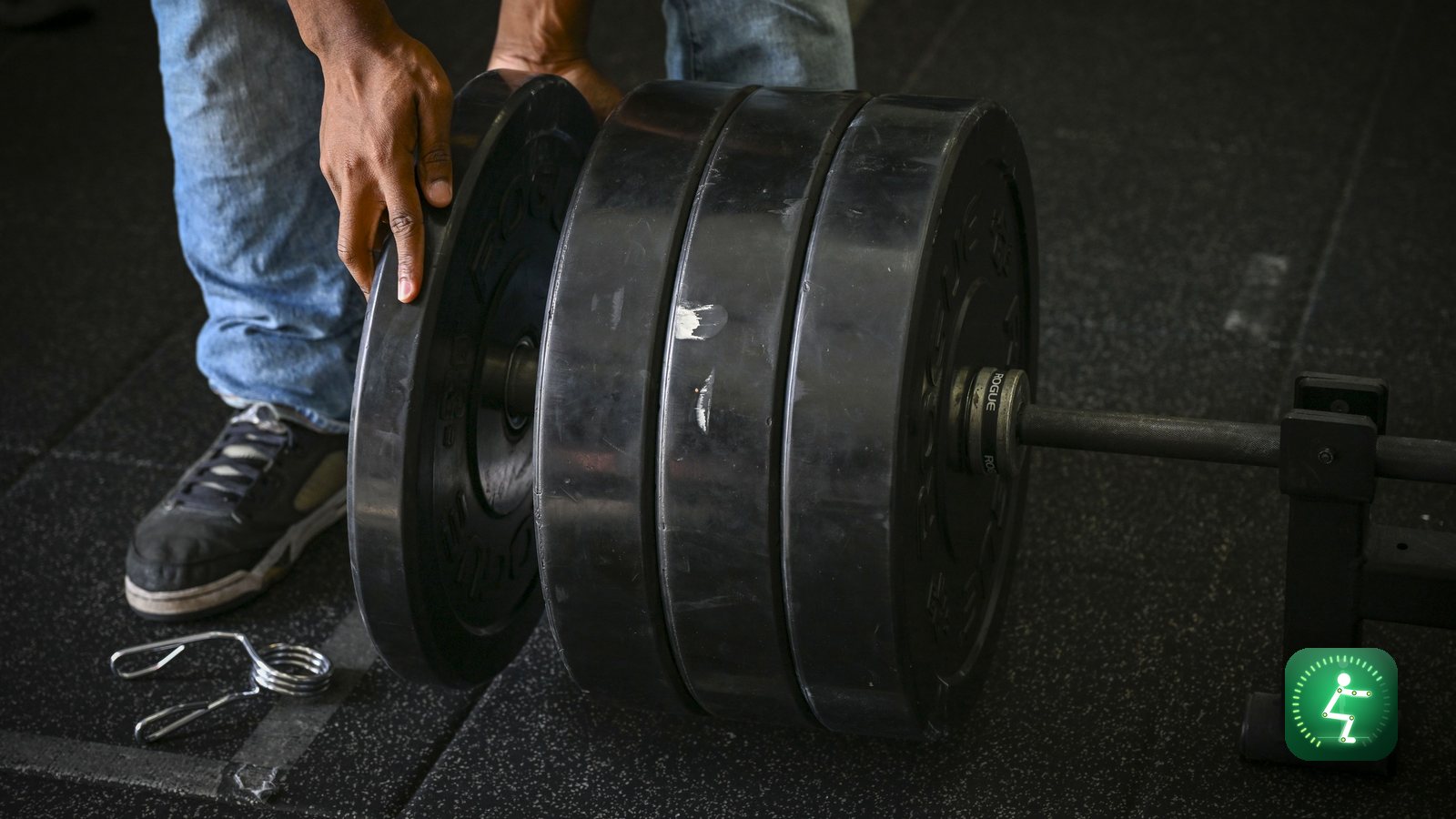
You walk in, do ten arm circles, load the bar to your working weight and feel stiff for the first two sets. Or you go the other way: twenty minutes of foam rolling and stretching, and you're tired before you squat. A good warm-up sits between the two. It takes 6 to 8 minutes and does one job: make your first work set feel like your third.
Step 1: General heat (2 to 3 minutes)
The goal is a slightly raised heart rate and warm muscles, not fatigue. Pick one:
- Bike, rower or brisk incline walk. Easy pace, where you could still hold a conversation.
- Jumping jacks and bodyweight squats. Three rounds of 20 jacks and 10 squats.
- Jump rope. Two minutes of easy skipping.
You should feel warm and maybe a little sweaty. If you're breathing hard, back off. This phase is about temperature, not conditioning.
Step 2: Mobility for today's lift (2 minutes)
Skip the full-body stretching routine. Choose two drills that match the movement you're about to load, 8 to 10 reps each.
- Squat day. Goblet squat holds with a light plate (pry your knees out with your elbows), then deep lunges with a reach overhead.
- Deadlift day. Hip hinges with a dowel along your spine, then glute bridges.
- Bench or overhead press day. Band pull-aparts, then slow push-ups with a full pause at the bottom.
Keep these dynamic: move in and out of the position rather than holding it. Research reviews have found that static stretches held for 60 seconds or longer per muscle can measurably reduce strength right afterward, while shorter holds have little effect. If something feels tight, a brief 20 to 30 second hold is fine. Save long stretching for after your session.
The best warm-up for a lift is the lift itself, done lighter.
Step 3: Ramp-up sets with exact percentages (3 minutes)
This is the part that actually transfers. You rehearse the exact movement with gradually heavier loads, so your body and your technique are ready for the real weight. Use your first work set as 100%.
- Empty bar x 10. Slow and deliberate. Check your setup, grip and depth.
- 40% x 5.
- 60% x 3.
- 80% x 2.
- 90% x 1 (only if your work sets are 5 reps or fewer).
Example for a 100 kg squat for 5: bar x 10, 40 kg x 5, 60 kg x 3, 80 kg x 2, 90 kg x 1, then your work sets. Rest only 30 to 60 seconds between ramp sets, and longer before the first working set. Notice the reps drop as the weight climbs. You want practice and readiness, not extra fatigue.
For the second and third lifts of the day, you need far less. Two or three ramp sets at 50% and 75% are plenty, because you're already warm.
What to skip
- Long foam rolling sessions. A minute on a stubborn spot is fine; ten minutes is a delay.
- High-rep ramp sets. Ten reps at 80% is a work set wearing a disguise.
- Random ab circuits. Core work belongs at the end.
- Skipping the warm-up on "light" days. Light days are when you practice the routine until it's automatic.
If you're new to barbells, our guide to starting strength training at home covers the basics before you load anything.
When your warm-up includes bodyweight squats or push-ups, prop your phone against a wall and run Form Coach. It draws a live skeleton over your body, counts reps from the front, side or behind, and gives every rep a form score, so you'll catch a shallow squat during the warm-up instead of under a heavy bar. It runs on your device, needs no account, and is free with no subscription.
Do the same eight minutes every session for a month, and the first set of the day will stop being the worst one.
Related posts
-
How-to
How to track lifting progress without a spreadsheet
Oct 13, 2026
-
How-to
How to start strength training at home with no equipment
Sep 30, 2026
-
How-to
How to do a proper push-up (and the easier versions that still count)
Oct 07, 2026
Recent posts
-
How-to
How to learn a trade as an adult (electrician, plumber, HVAC, welding)
Oct 20, 2026
-
How-to
How to watch a game later without spoilers
Oct 19, 2026
-
How-to
How to photograph fall colors with your phone
Oct 19, 2026
-
How-to
How to spot a scam text before you tap
Oct 18, 2026
-
How-to
How to steam milk for a latte at home
Oct 17, 2026
-
How-to
How to compare Medicare plans for a parent during open enrollment
Oct 16, 2026
0 comments
No comments yet — be the first.
Leave a reply
Sign in with Google to join the conversation. We require a quick sign-in to keep comments spam-free.
Sign in with Google to comment