How to run truck yard check-in without a clipboard
What a yard check-in log needs to capture, where the paper register breaks down, and how clean arrival and departure times settle detention disputes.

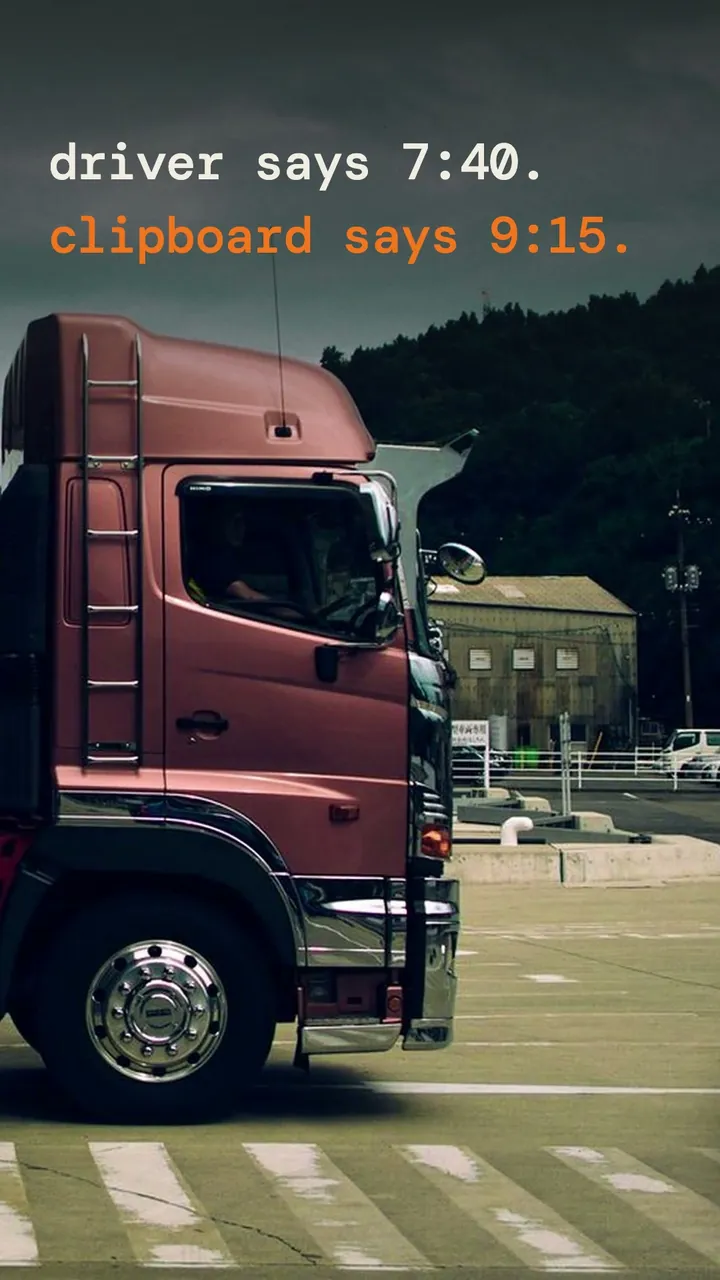
A driver says he arrived at 7:40. The gate register says 9:15, in handwriting nobody can quite read, on a sheet that was filled in from memory after the morning rush. The carrier bills three hours of detention and the shipper disputes all of it. Nobody is lying, exactly. The paper simply wasn't built to answer the question everyone is now asking.
What a check-in log actually needs
A yard log earns its keep when it can reconstruct any truck's visit weeks later. That means capturing the same fields every time, at the moment they happen:
- Who. Carrier or transporter name, driver name and mobile number.
- What. Vehicle or trailer number, the order or delivery document number, origin or destination.
- The seal. Seal number on arrival, checked against the paperwork before it's cut.
- Where. Which dock or door the truck was assigned, and who supervised it.
- When. Gate-in, on dock, unloading started, completed, gate-out.
For seals, US Customs and Border Protection teaches a simple check called VVTT: view the seal and locking hardware for tampering, verify the number against the documents, then tug and twist it to make sure it's properly fixed. Write down what you found either way. A seal note that says "matched, intact" is worth as much as one that flags a problem.
Where paper breaks
The clipboard fails in predictable ways, and almost never all at once:
- Legibility. A 1 becomes a 7, a trailer number loses a digit, a time is smudged.
- Back-filling. During a rush, entries get written later from memory. That's exactly when times drift.
- Lost sheets. A register page goes missing, gets wet or sits in a cab for a week.
- No link between records. The gate book, the unload memo and the damage report live in three places, so matching a shortage to a truck means a search.
- No summary. When a manager asks what's still open, someone has to count by hand.
A simple digital flow
You don't need a warehouse management system to fix this. A phone with a structured form does most of the work:
- Gate-in. Create the visit with the carrier, vehicle, document number and seal check.
- Assign. Pick the dock, supervisor and crew, and move the status to on dock.
- Unload. Record what came off, line by line, including anything damaged or short.
- Raise issues on the spot. A shortage or damage becomes its own record tied to that truck, not a note in the margin.
- Gate-out. Close the visit so the truck leaves the open list.
The key is that each step is a tap at the moment it happens, not a line written up afterward.
Detention disputes are rarely about honesty. They are about which record was written closest to the moment.
How clean times settle detention arguments
Detention is time a truck waits beyond the agreed free time to load or unload. Two hours is a common industry norm, though it's set by contract and varies by agreement. Federal research has found that longer detention also raises crash risk, so it isn't just a billing issue.
When arrival, dock and departure times are logged as they happen, the conversation changes. Instead of two memories, there's one record everyone can see. If the truck arrived early for its appointment, that's visible. If the dock was the delay, that's visible too, and fixable.
DockLedger is built for exactly this kind of yard. It logs every truck from gate-in to gate-out with vehicle number, transporter, DO number, tonnage, dock, supervisor and labour gang, moving through At Gate, On Dock, Working, Completed and Gate Out. The unload memo mirrors the printed inspection form, and shortages or damage become tracked issues that move from Open to Closed. Daily and monthly reports share as clean text in one tap. It's free, works fully offline and needs no account. The DockLedger walkthrough goes deeper.
Put the clipboard down for one week, and the first detention call that comes in will show you why it's not coming back.
Videos
Watch this post as a reel
Related posts
-
Product
How DockLedger takes a truck yard off paper without a server
Sep 14, 2026
-
How-to
How to run a game night scoreboard everyone actually trusts
Sep 16, 2026
-
How-to
How to check your squat form with nothing but your phone
Sep 05, 2026
Recent posts
-
How-to
How to learn a trade as an adult (electrician, plumber, HVAC, welding)
Oct 20, 2026
-
How-to
How to watch a game later without spoilers
Oct 19, 2026
-
How-to
How to photograph fall colors with your phone
Oct 19, 2026
-
How-to
How to warm up before lifting in 8 minutes (and what to skip)
Oct 18, 2026
-
How-to
How to spot a scam text before you tap
Oct 18, 2026
-
How-to
How to steam milk for a latte at home
Oct 17, 2026
0 comments
No comments yet — be the first.
Leave a reply
Sign in with Google to join the conversation. We require a quick sign-in to keep comments spam-free.
Sign in with Google to comment