How to journal your day in sixty seconds
Long journaling habits tend to die in week two. A fixed format, a handful of lines and a daily trigger make a one-minute entry you will actually keep writing.
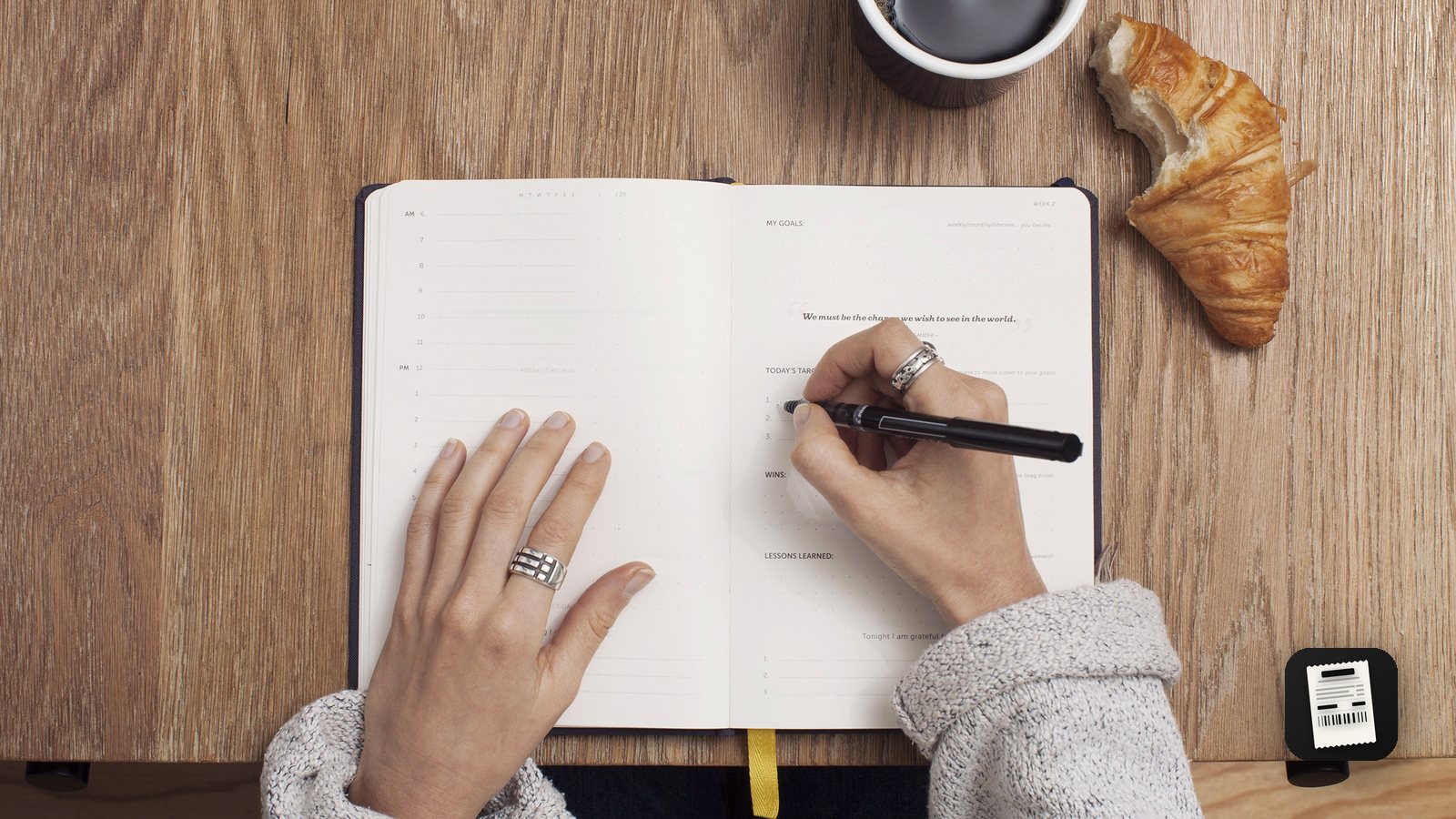
Most journals end the same way. A beautiful notebook, four long entries in the first week, one guilty entry in the third, then a drawer. The writing was never the problem. The blank page was. Every entry asked you to decide what to write, how much, and in what shape, and on a tired Tuesday that is three decisions too many.
A sixty-second journal removes all three. It's smaller than you think a journal should be, and that is exactly why it lasts.
Fix the format before you write a word
Decide once what a day's entry contains, then never decide again. A good daily format has three to five line items, each one answerable in a few words:
- Mood, in one word.
- The biggest win, however small.
- One thing you're grateful for.
- The song, meal or moment you'd want to remember.
- A one-line verdict on the day.
The items should be specific enough that you can't stall on them. "How do I feel about my life" is an essay. "Mood, one word" is an answer. When the prompts are fixed, you're filling in blanks, not composing, and filling in blanks takes about a minute.
Resist adding lines. Five lines is something you finish. Twelve lines is something you skip, and a skipped day tends to become a skipped week.
Tie it to something you already do
Habits stick when they ride on an existing routine. Pick a trigger you never miss: plugging your phone in at night, the kettle boiling, sitting down on the train home. The trigger matters more than the time of day, because a clock can be ignored and a routine can't.
Keep the journal one tap from that moment. If you have to find a notebook, a pen and a quiet corner, you won't. If the entry is on the phone already in your hand, you will.
When you miss a day, don't back-fill it from memory. Write today's and move on. A journal with gaps is still a journal. A journal you abandon because it has gaps is not.
Review weekly, not daily
The payoff of a tiny journal doesn't show up in any single entry. It shows up when you line seven of them up. Once a week, read the last seven days in one sitting. You'll notice things no single entry reveals: the mood that dipped every Wednesday, the win that was always about the same project, the gratitude line that kept naming the same friend.
A single entry is a note. Seven entries in a row are a pattern you can actually do something about.
That weekly read is also where you tune the format. If one line is always blank, swap it for something you'd actually answer.
A worked example: the day as a receipt
A receipt is a surprisingly good journal format. It's already a fixed list of line items with a total at the bottom, and nobody expects a receipt to be long.
Receiptd uses exactly that shape. Its Daily Receipt asks for your mood, biggest win, top song, something you're grateful for, and a witty total for the day, then builds a retro thermal receipt live as you type, complete with a timestamp, a dashed divider and a faux barcode. There are also Habit, Gratitude and Year templates, and every receipt saves to a Shoebox you can scroll back through for the weekly review. It's free, needs no account, and works entirely offline on iPhone and iPad.
The format makes the minute feel like a small reward instead of homework, and that's most of what keeps a habit alive. If you like this kind of repeatable daily record, the same thinking shows up in how to build a photo-a-day habit.
Start tonight with five lines. A year from now you'll have 365 small pieces of your life you would otherwise have forgotten.
Recent posts
-
How-to
Is the America the Beautiful pass worth it? Do the math first
Oct 08, 2026
-
How-to
How to do a proper push-up (and the easier versions that still count)
Oct 07, 2026
-
How-to
How to read a company's earnings report in ten minutes
Oct 06, 2026
-
How-to
How to share caring for a parent between siblings without resentment
Oct 06, 2026
-
AI & Trends
What to do when an app you rely on shuts down
Oct 05, 2026
-
How-to
How to cut food waste at home without trying harder
Oct 04, 2026
0 comments
No comments yet — be the first.
Leave a reply
Sign in with Google to join the conversation. We require a quick sign-in to keep comments spam-free.
Sign in with Google to comment