
Health And Fitness
FallTrail: fall diary & report
Fall diary, patterns & report
No account, no install. What you do stays in your browser.
This app is a community proposal.
Try the full browser version now. We build the iPhone and Android app once 100 people upvote it.
We'll email you once, when it ships. Unsubscribe anytime.
| Price | Free, no subscription |
|---|---|
| Account | None needed to try |
| Works offline | Yes |
| Data | On your device, never on our servers |
| Platforms | Browser |
| Status | Community proposal (built for phones at 100 upvotes) |
| Last updated | 2026-07-08 |
Accessibility: Larger Text · Light & Dark · VoiceOver labels · iPad layout · Browser version How we checked →
 Try it live
The full FallTrail, right here in your browser.
No account and no install. What you enter is saved in this browser only, never on our servers.
Open FallTrail →


About this app
What FallTrail does
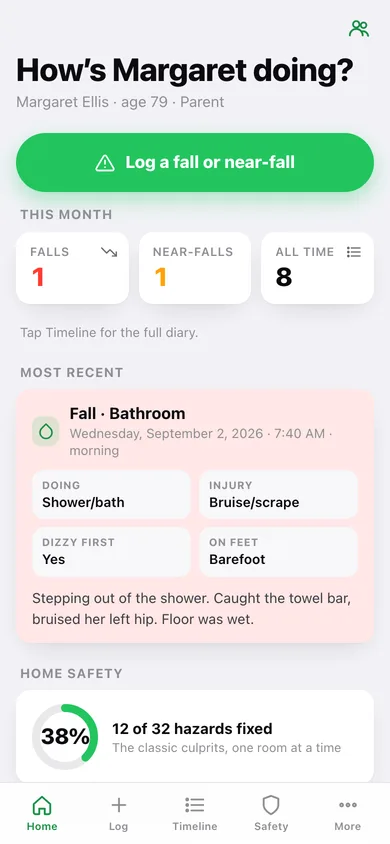
One in four adults over 65 falls every year, and after every fall the same question comes from the ER doctor, the physical therapist, and the Medicare wellness visit: how many falls this year, and what was happening each time? For most families the honest answer lives on a sticky note on the fridge — if it lives anywhere at all. FallTrail is a 20-second fall and near-fall diary built for exactly that question. When something happens, open the app and tap through what matters: fall or near-fall, which room, what they were doing, any injury, dizziness beforehand, what was on their feet. That's it. Months later, when the physical therapist asks about circumstances, the answer is on your phone instead of in anyone's memory. Near-falls are the part every other tool misses. A smartwatch only registers hard-impact falls while it is worn, and captures zero context. But the stumbles and grabs for the counter are the early warnings clinicians actually ask about — FallTrail treats them as first-class entries. Log a handful of events and FallTrail shows the shape of the problem: falls clustering in the bathroom, near-falls mostly at night, a frequency trend that is easier to discuss as a chart than a feeling. Before an appointment, generate a clean, STEADI-style fall-history report — dates, circumstances, injuries, patterns — formatted to hand to a clinician, so intake starts from facts. FallTrail also includes a room-by-room home-hazard checklist covering the classic culprits: loose rugs, poor lighting, missing grab bars, clutter. Work through it one room at a time and track what is fixed. Track one person or several — both parents, a grandparent, yourself. Everything stays on the device: no account, no monitoring service, no monthly fee. FallTrail is a record book, not a medical device — it never predicts risk or offers a diagnosis. It just makes sure that when a clinician asks about fall history, somebody finally has the answer.
Features
Built to be useful, not noisy.
Quick Fall Log
A 20-second guided entry: fall or near-fall, date and time, room, activity, injury severity, dizziness beforehand, footwear, optional photo and note. Designed so a stressed caregiver can finish it one-handed.
Timeline & Patterns
A scrollable event timeline plus a pattern dashboard: falls by room, by time of day, near-fall vs fall ratio, and a monthly frequency trend chart that makes 'it's getting worse' provable.
STEADI-Style Report
Generates a clean fall-history summary — event table with circumstances, injury flags, pattern highlights, and hazard-fix status — rendered as a shareable PDF to hand to a PT or doctor at intake.
Home Hazard Checklist
A room-by-room checklist of the classic fall hazards (loose rugs, lighting, grab bars, clutter, cords) with per-room progress rings and a resolved/pending state for every item.
People Profiles
Track more than one person — both parents, a grandparent, yourself — each with their own diary, checklist, and report, switchable from anywhere.
Balance Streaks
Log the balance-exercise homework PTs assign (sit-to-stands, heel-toe walks, single-leg stands) and keep a gentle streak going, with minutes-per-week totals.
Why it exists
The problem
Clinicians running CDC STEADI assessments, PTs, and ER doctors all ask for a structured fall history — when, where, what the person was doing, injuries, near-misses — and families track it on sticky notes or a printable PDF, so at intake nobody can answer 'how many falls this year and under what circumstances?'
What's different
How FallTrail stands out
Apple Watch fall detection and Apple Health's 'Number of Times Fallen' only auto-log hard-impact falls while a Watch is worn — no manual entry, no near-falls, no context, no report. FallCall Detect, Lively, and other medical-alert apps are subscription emergency-monitoring services that alert after a fall but keep no…
You might also like
All apps →
Roundbell
Health And Fitness
Tabata, EMOM & Boxing Rounds

Footfall
Health And Fitness
Free Pedometer, No Ads

Yoga Coach
Health And Fitness
Free AI yoga trainer with real pose feedback

Resonate: Voice Trainer
Health And Fitness
Pitch and resonance, live

StrideLab: Run Form
Health And Fitness
Running form from a slo-mo

PaceGrid
Health And Fitness
Split your race, hit your time
FAQ
Questions about FallTrail
How much does FallTrail cost?▾
FallTrail is free. All features are included from day one — no subscription, no in-app purchases, no paid tiers. Everything you see in this listing works the moment you install it.
Where does FallTrail store my data?▾
FallTrail stores what you enter on your device. No account is required, and we never sell your data. Any anonymous usage data or optional notifications are explained in the FallTrail privacy policy.
What platforms does FallTrail support?▾
iOS, on iPhone and iPad. You can find the latest availability on this page.
How do I get support for FallTrail?▾
Use the Support link on this page, or email support@allthingsn.com. We answer every message and keep responses on the same thread.
Related guide
Best offline fitness tracker apps, 2026
More fitness & workouts apps with no subscription →
More in Health And Fitness

