
Lifestyle
HayDays: hay run-out forecast & planner
Hay run-out forecast & planner
No account, no install. What you do stays in your browser.
This app is a community proposal.
Try the full browser version now. We build the iPhone and Android app once 100 people upvote it.
We'll email you once, when it ships. Unsubscribe anytime.
| Price | Free, no subscription |
|---|---|
| Account | None needed to try |
| Works offline | Yes |
| Data | On your device, never on our servers |
| Platforms | Browser |
| Status | Community proposal (built for phones at 100 upvotes) |
| Last updated | 2026-07-08 |
Accessibility: Larger Text · Light & Dark · VoiceOver labels · iPad layout · Browser version How we checked →
 Try it live
The full HayDays, right here in your browser.
No account and no install. What you enter is saved in this browser only, never on our servers.
Open HayDays →


About this app
What HayDays does
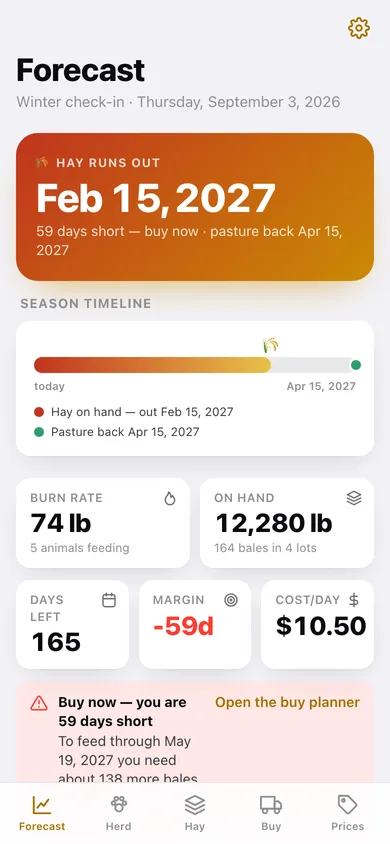
Running out of hay in February is the most expensive mistake in the barn. The bales that cost 9 dollars in July are 18 in late winter — if you can find any at all. HayDays exists so that never happens to you again. Every fall, horse and livestock owners stand in the feed room doing the same pencil math: pounds per day, times head, times days until pasture. University extension services publish whole worksheets for it. HayDays does that math continuously, automatically, and honestly — including the part everyone forgets: waste. Build your herd once. Add each horse, goat, sheep, or cow with its bodyweight, and HayDays applies the standard 2 percent-of-bodyweight intake rule (tunable per animal) plus a waste percentage for what gets trampled, soaked, and refused. That is your true daily burn rate in pounds. Then count what is in the barn. Log your hay by the lot — bale count, bale weight, what you paid. From there, HayDays draws the line that matters: your projected run-out date, plotted directly against the date your pasture comes back. Green means you clear the winter. Amber means it is close. Red means buy now, and the buy planner tells you exactly how many bales to order, with a safety margin you control. Hay pricing is deliberately confusing — 50-pound squares at one price, 4x5 rounds at another. HayDays normalizes every quote to dollars per ton so you can compare suppliers in one glance and keep a price book of who sold what, when, for how much. Next fall, you negotiate with receipts. Everything is offline and on-device. No account, no subscription, no cloud. Your barn, your numbers, your phone — even in a metal barn with no signal. Built for the 1-to-10-horse backyard barn, the goat and sheep homestead, and the small cattle operation that buys hay by the load and feeds through a winter.
Features
Built to be useful, not noisy.
Herd Model
Add each animal with species, bodyweight, intake percentage (defaults to the extension-standard 2 percent of bodyweight), and a waste percentage per feeder setup. HayDays sums it into the herd's true daily burn rate in pounds.
Hay Inventory
Log hay by the lot: bale count, bale weight, price paid, supplier, and date acquired. Decrement bales as you feed them or let the burn rate estimate depletion automatically.
Run-Out Forecast
The headline screen: total pounds on hand divided by the herd burn rate produces a projected run-out date, drawn on a timeline against your pasture-return date with a green/amber/red verdict and days-of-margin number.
Buy Planner
Pick a target date (pasture return plus your safety margin) and HayDays computes exactly how many bales of a given weight to buy, and what that order should cost at your best recorded supplier price.
Supplier Price Book
Record every quote — 50 lb squares at 9 dollars, 4x5 rounds at 70 — and see them all normalized to dollars per ton, ranked cheapest first, with supplier contact notes and quote history.
Why it exists
The problem
Owners must answer 'how many bales do I buy this fall?' and 'will I run out before spring?' with error-prone pencil math that ignores waste; running out in February means paying double for scarce hay. Existing apps either only count bales (HayTracker) or lock a days-left number inside a subscription nutrition platform…
What's different
How HayDays stands out
HayTracker (free) is inventory-and-cost counting only — no herd consumption model, no run-out date, no buy planner; HayDays' entire point is the forecast. EquineGo computes days-of-feed-left but behind a subscription, cloud accounts, and a full equine nutrition platform; HayDays is one-time, offline, and species-agnos…
You might also like
All apps →
Auraboard
Lifestyle
Your daily aesthetic vibe, as a shareable aura card.

Weekdots: Life in Weeks
Lifestyle
See your life in weeks

Ins & Outs
Lifestyle
Make shareable editorial list cards

Receiptd
Lifestyle
Turn your day into a retro receipt

Blind Box Vault
Lifestyle
Collect, complete, trade your figures

AptBook
Lifestyle
Tour, compare, see true rent
FAQ
Questions about HayDays
How much does HayDays cost?▾
HayDays is free. All features are included from day one — no subscription, no in-app purchases, no paid tiers. Everything you see in this listing works the moment you install it.
Where does HayDays store my data?▾
HayDays stores what you enter on your device. No account is required, and we never sell your data. Any anonymous usage data or optional notifications are explained in the HayDays privacy policy.
What platforms does HayDays support?▾
iOS, on iPhone and iPad. You can find the latest availability on this page.
How do I get support for HayDays?▾
Use the Support link on this page, or email support@allthingsn.com. We answer every message and keep responses on the same thread.
More in Lifestyle

