
Web app · Finance
Claimwise
Document your home, file the claim yourself, keep the whole settlement
The adjuster's workbench for homeowners: a room-by-room contents inventory checked against your Coverage C limit, a damage vault keyed to the date of loss, a dated claim diary, an ALE tracker against Coverage D, a one-page loss summary and 40 insurance terms in plain language. Free, no account.
Stored in your browser only. Nothing you do in the web version is sent to our servers. Clear your browser data and it's gone — so export a backup from the in-app menu if you want to keep it.
This app is a community proposal.
Try the full browser version now. We build the iPhone and Android app once 100 people upvote it.
We'll email you once, when it ships. Unsubscribe anytime.
In your browser
What you can do in Claimwise on the web
Room-by-room contents inventory
Item, brand, model, serial, year purchased and replacement value across twelve rooms — with the built-in template prompts (the categories that show up on every Coverage C contents form) so a whole house gets documented in an evening.
Underinsurance warning that actually computes
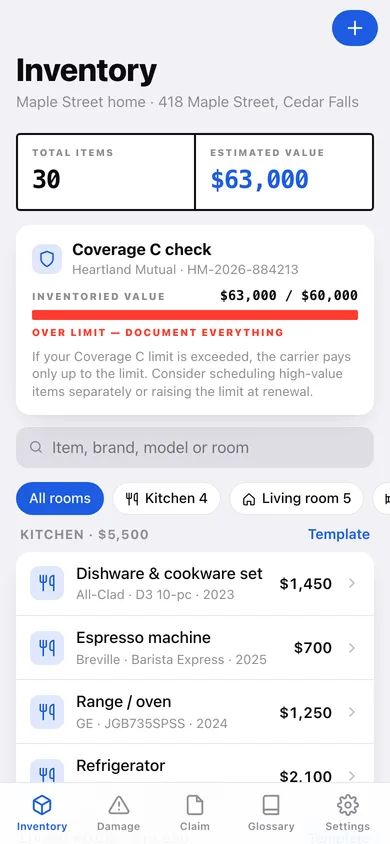
Your documented contents value is measured against the Coverage C limit on your policy and reported as under limit, approaching limit at 80%, or over limit — the point at which the carrier pays only up to the limit no matter what you prove.
Damage vault keyed to the date of loss
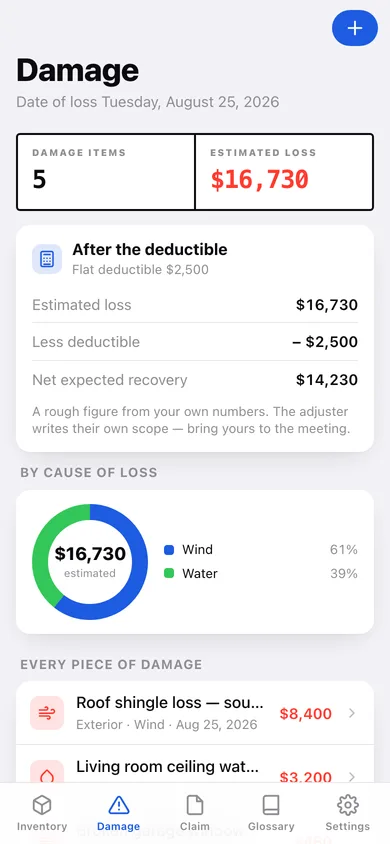
Each piece of damage gets a room, a cause of loss (wind, water, fire, hail, theft), a date and a repair estimate. Totals split by cause, and the net expected recovery after your deductible — flat dollars or a percentage of Coverage A, the way wind and hurricane deductibles are actually written.
Policy register and claim diary
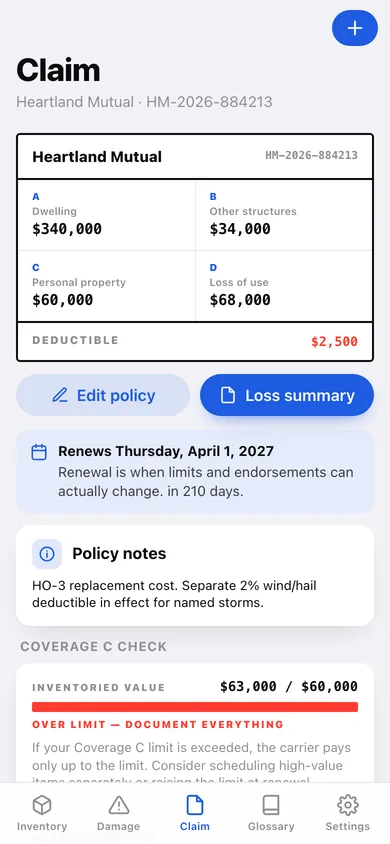
Carrier, policy number, Coverage A/B/C/D limits, deductible type and renewal date on one declarations-style card — plus every call, email, text, in-person visit and letter with your adjuster, dated and quotable.
ALE tracker against Coverage D
Hotel nights, meals, gas and laundry while the house is uninhabitable, logged to the cent, totalled by category and measured against your loss-of-use limit so you don't blow through it by accident.
The one-page loss summary
Policy, damage list, contents inventory by room, ALE running total and the full claim diary assembled into the packet you hand the adjuster on day one — copy it or download it.
40-term plain-language glossary
RCV vs ACV, recoverable depreciation, proof of loss, scope, supplement, betterment, subrogation, anti-concurrent causation, appraisal clause — searchable and grouped by valuation, coverage, cost, process and roles.
Screens
Every screen, rebuilt for the browser
-
1
Inventory
Documented contents value against the Coverage C limit, with every item grouped by room.
-
2
Claim
The declarations card, the Coverage C check, the ALE meter and the claim diary.
-
3
Damage vault
Estimated loss, net recovery after the deductible, a split by cause and every damage record.
-
4
Item detail
One documented item: brand, model, serial, year, value and any damage in that room.
-
5
Add an item
Name, room, brand, model, serial, year purchased, replacement value and notes.
-
6
Damage record
One loss: cause plate, room, date of loss, estimate and a copyable line for the adjuster.
-
7
Log damage
What was damaged, the room, the cause of loss, the date and the repair estimate.
-
8
Policy register
Carrier, policy number, Coverage A/B/C/D, deductible type and amount, renewal date.
-
9
Claim diary entry
Date, channel, who you spoke to and exactly what was said.
-
10
ALE tracker
Additional living expenses by day and category, measured against Coverage D.
-
11
Log an ALE expense
Date, category, amount, vendor and note — stored to the cent.
-
12
Loss summary
The one-page packet: policy, damage, inventory, ALE and diary, ready to copy or download.
-
13
Glossary
All 40 insurance terms, searchable and grouped by category.
-
14
Term
One term explained in plain language, with the rest of its category.
-
15
Settings
Property details, policy, CSV exports, backup, sample data and erase.
Try it with sample data: Loads a documented 2,240 sq ft home — 30 inventory items worth $63,000 against a $60,000 Coverage C limit, so the underinsurance warning fires — plus a windstorm loss nine days ago with five damage records, five adjuster diary entries and eight nights of living expenses. You can start fresh at any time.
Ready? It's free.
No account, no install, no subscription. Everything you do stays in this browser.
Your say
What should Claimwise do? Tell us before we build it.
Tell us what to build next.
Comments need a free Google sign-in, so every one is from a real person.
Sign in with Google to commentNo comments yet — be the first to say what this app should do next.
Questions
Is the web version of Claimwise free?+
Yes. Every screen is free to use: no subscription, no in-app purchases, no account.
Do I need an account?+
No. Open Claimwise and start using it right away. Sign in with Google only if you want to upvote an app, save it to your list, or leave a comment.
Where is my data stored?+
Only in this browser's local storage. Nothing you enter is sent to our servers, so we can't see it, back it up, or restore it. Clearing site data, a private window, or another device starts empty. Export a backup from the in-app menu to keep it.
Is there a Claimwise app for iPhone or Android?+
Not yet. Claimwise is a community proposal: the browser version is complete, and we build the iPhone and Android app once 100 people upvote it. Upvoters get one email when it ships.