Meet Taikyo Check — Fair move-out fees in Japan
Fair move-out fees in Japan

Finance
Taikyo Check
Fair move-out fees in Japan
Every feature, from the first launch.
No account, no login, no cloud. Everything runs on your device and works fully offline — nothing in this post is hidden behind a wall.
What Taikyo Check does
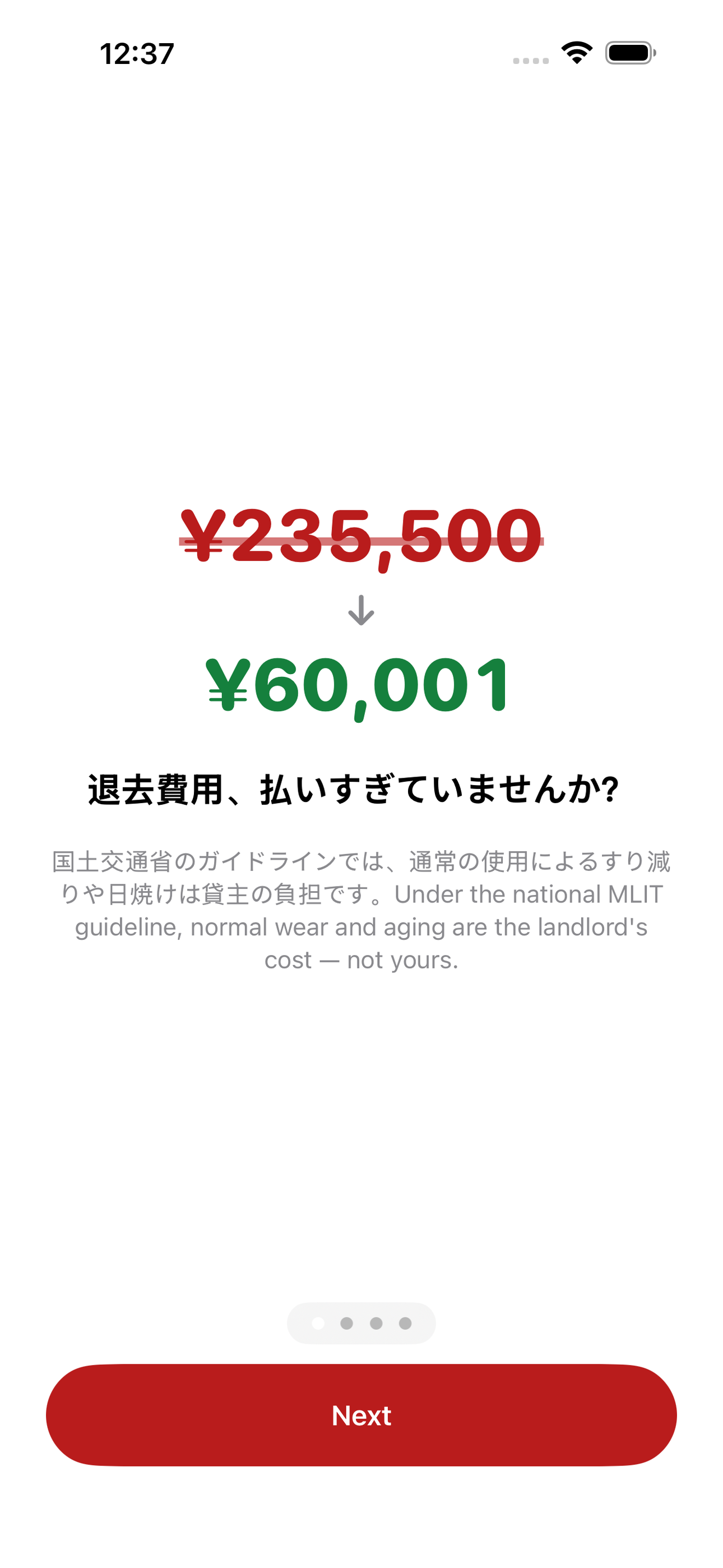
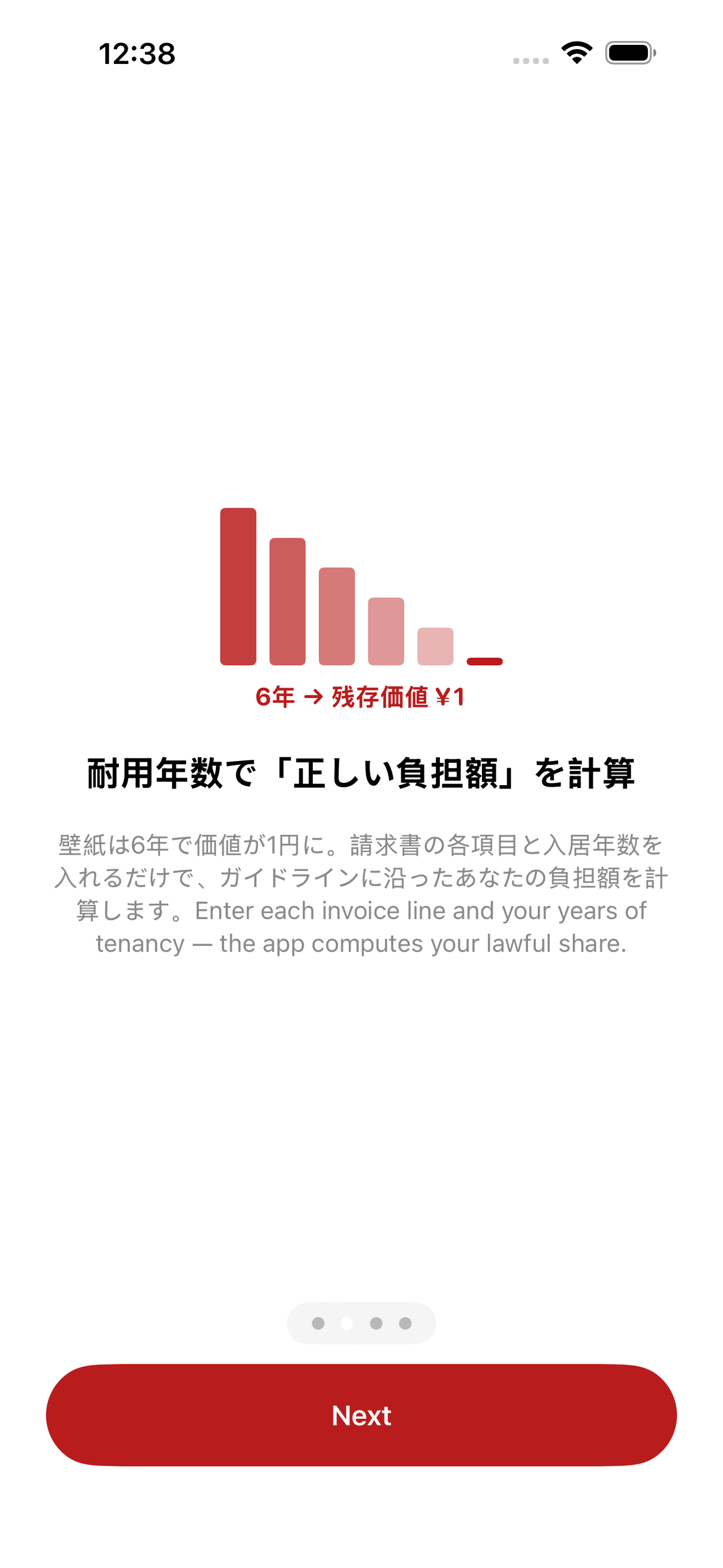
Moving out of a rental in Japan too often ends with a shock: a genjo kaifuku (restoration) invoice demanding full wallpaper replacement, tatami work, floor repair, and cleaning — sometimes hundreds of thousands of yen. Yet the national MLIT guideline is clear: normal wear and aging are the landlord's cost, and materials depreciate over a statutory useful life. Wallpaper, for example, falls to a residual value of just one yen after six years. Japan's National Consumer Affairs Center logs more than ten thousand consultations on exactly these disputes every year, and hiring a human deposit consultant costs 16,000 to 24,000 yen — often more than the disputed amount itself.
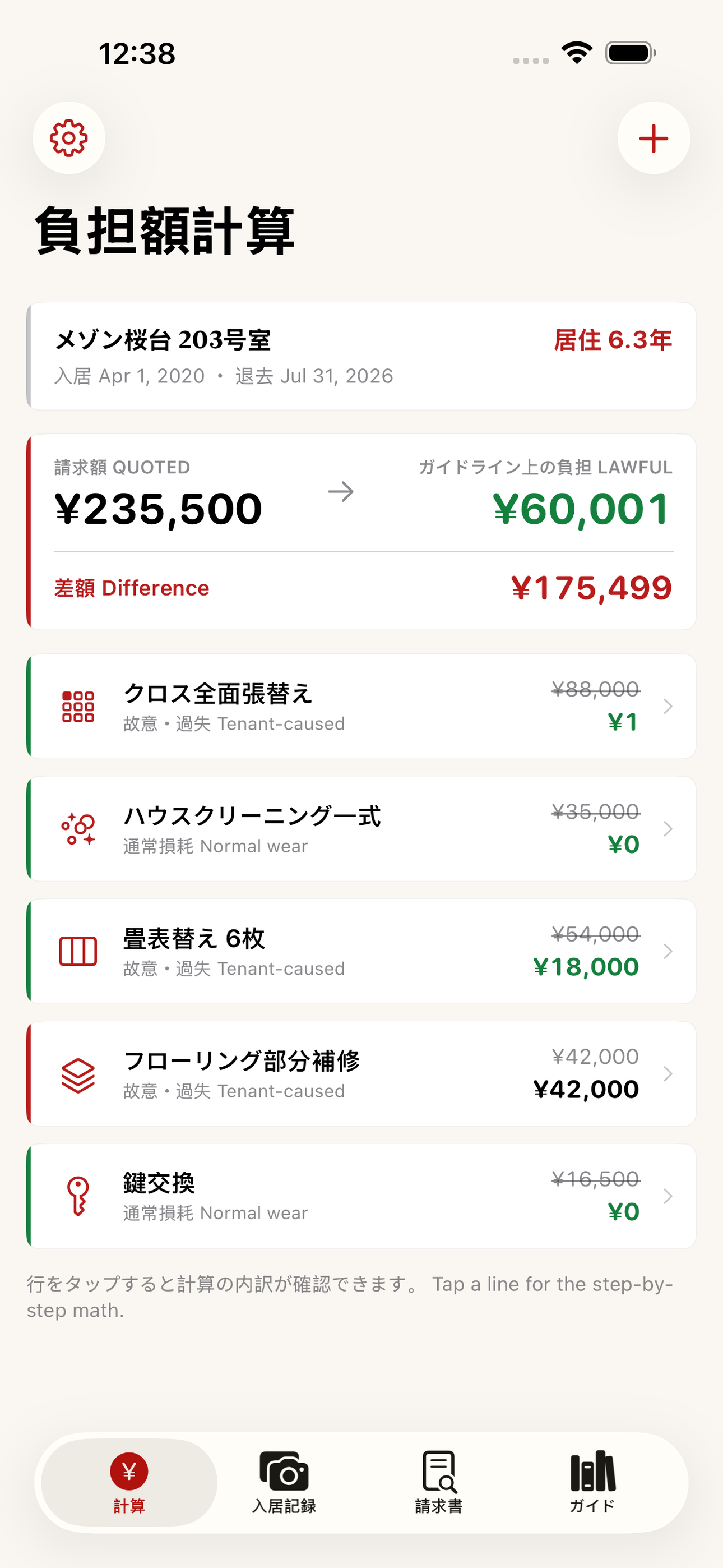
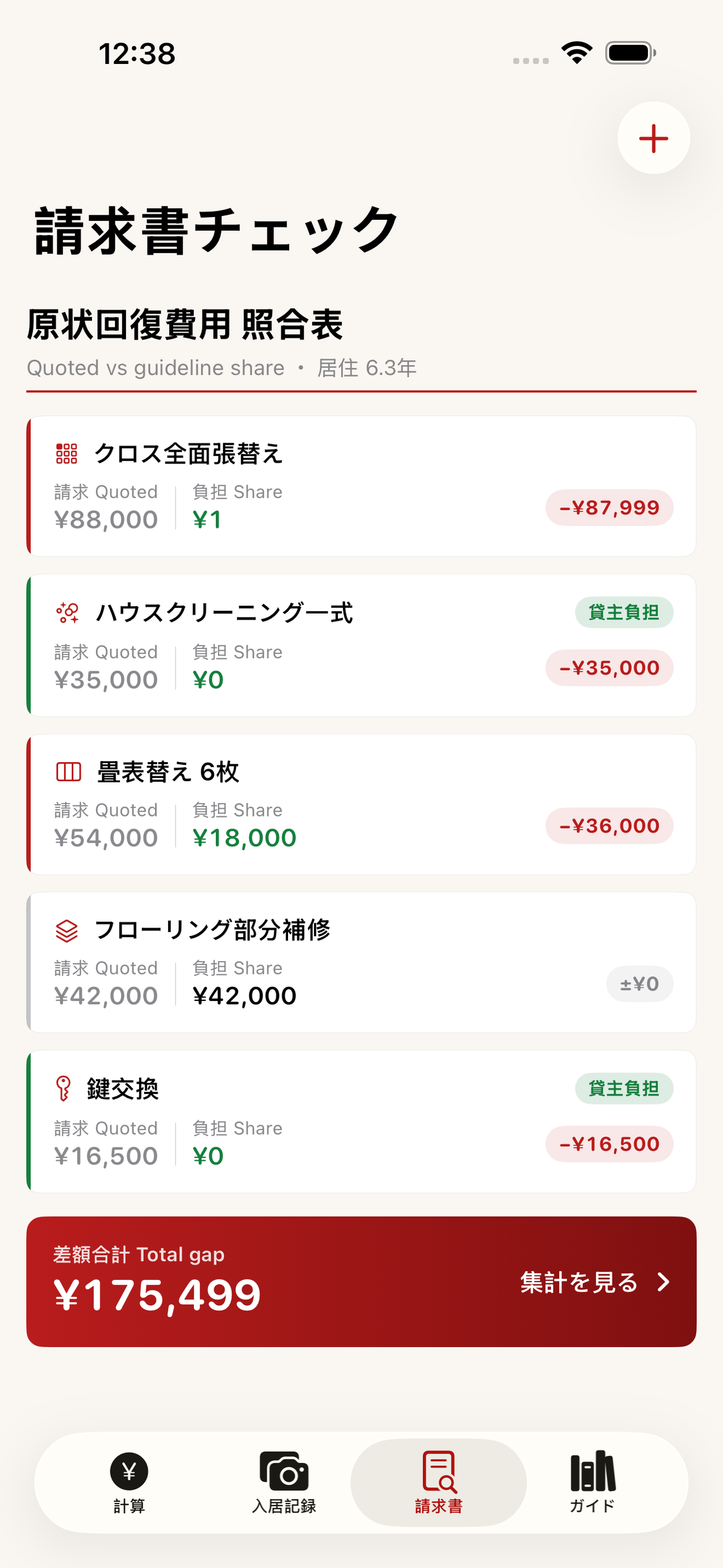
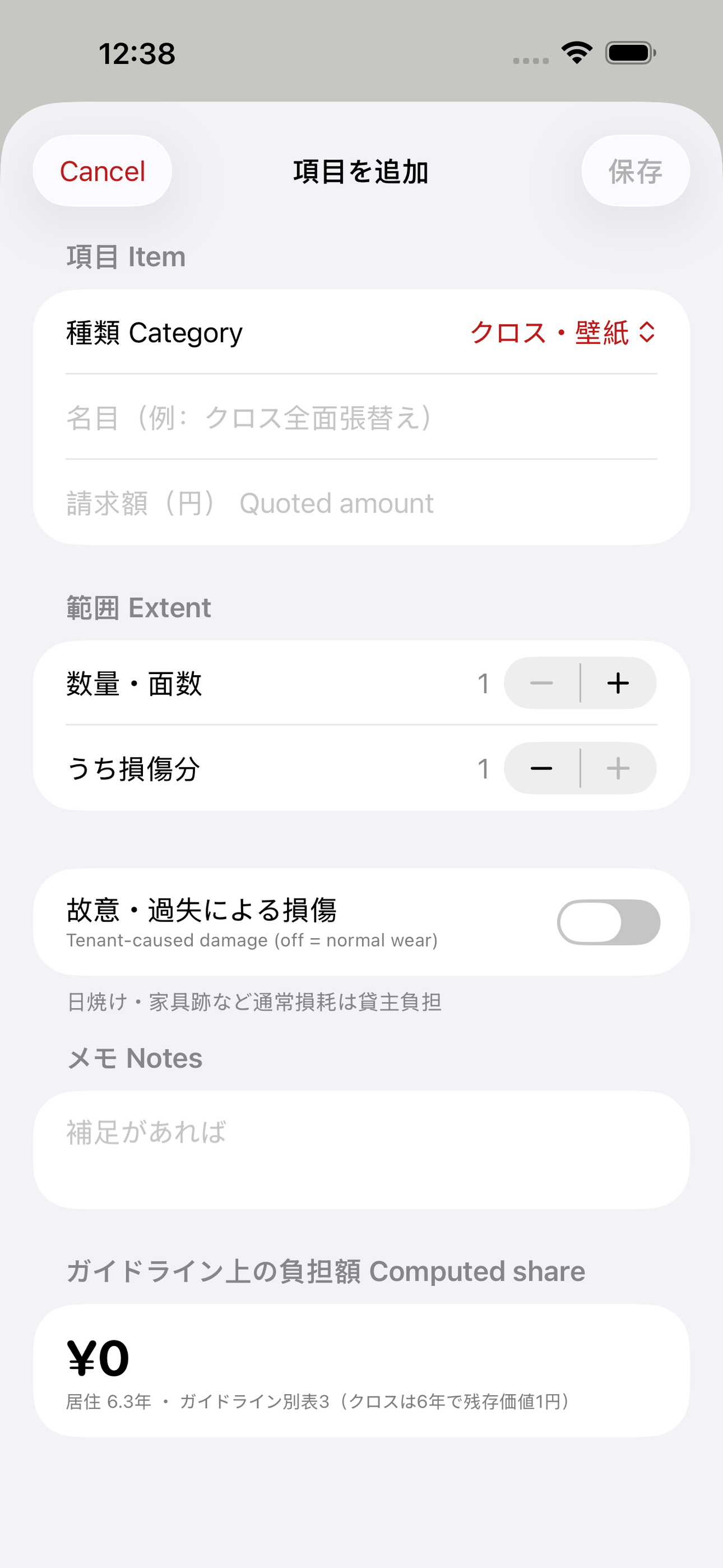
Taikyo Check puts the guideline math in your pocket. Enter each line of the invoice — wallpaper, tatami, flooring, cleaning, key exchange — along with how long you lived in the unit, and the app computes the lawful tenant share using the statutory useful-life depreciation the guideline prescribes. What looked like an 88,000 yen wallpaper bill after six years of tenancy is, under the guideline, a one-yen residual.
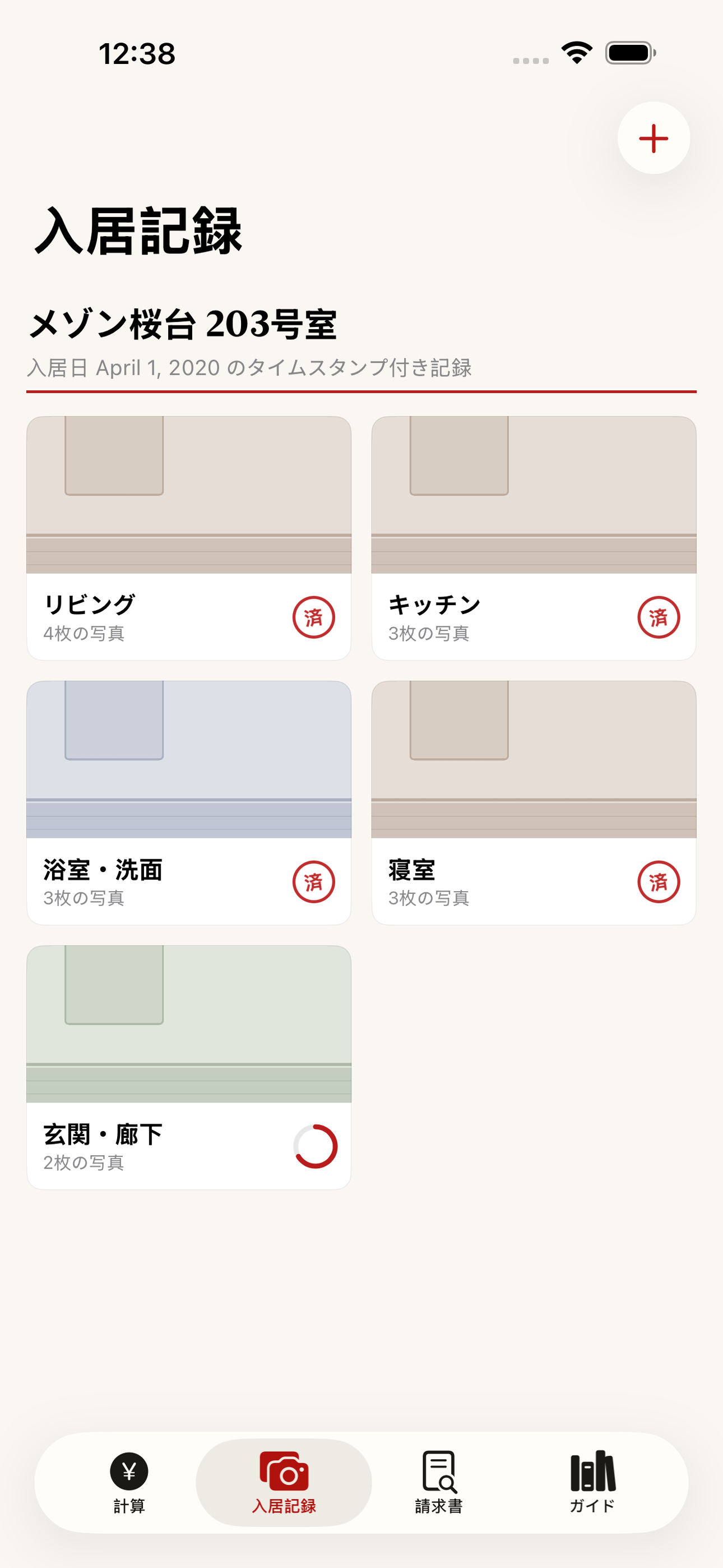
Your strongest position starts on day one, not move-out day. The move-in binder walks you room by room, capturing timestamped photos of every wall, floor, and fitting, so pre-existing scratches and stains can never be billed to you years later. When move-out day comes, the itemized challenge sheet compares the landlord's quote against your computed share line by line, and the letter builder drafts a polite, firm negotiation letter in Japanese that cites the relevant guideline sections — ready to send or to bring to a consumer affairs consultation, with a PDF export of your full evidence file.
Everything stays on your device. No account, no server, and your photos and dispute details are never shared with anyone.
Taikyo Check is a reference and record-keeping tool based on the publicly available MLIT guideline. It does not give legal advice, and special contract clauses (tokuyaku) in your individual lease may change what applies to you.
• Depreciation calculator built on the MLIT guideline useful-life tables • Line-by-line invoice challenge sheet with your computed lawful share • Timestamped move-in photo binder, organized room by room • Japanese negotiation letter builder citing guideline sections • PDF export of evidence and calculations for consumer center visits • Fully offline and private — your records never leave your phone
A look inside
Tap any screenshot to open the full-resolution version.
What's inside
- Depreciation Calculator — Enter an invoice line (wallpaper, tatami, flooring, cleaning, key exchange), the quoted amount, and your years of tenancy; the app applies the MLIT statutory useful-life depreciation curve and returns the lawful tenant share — down to the 1-yen residual for fully depreciated items.
- Move-In Photo Binder — A room-by-room walkthrough on day one of the lease: capture timestamped photos of every wall, floor, fixture, and existing scratch, organized by room, so nothing pre-existing can be billed at move-out.
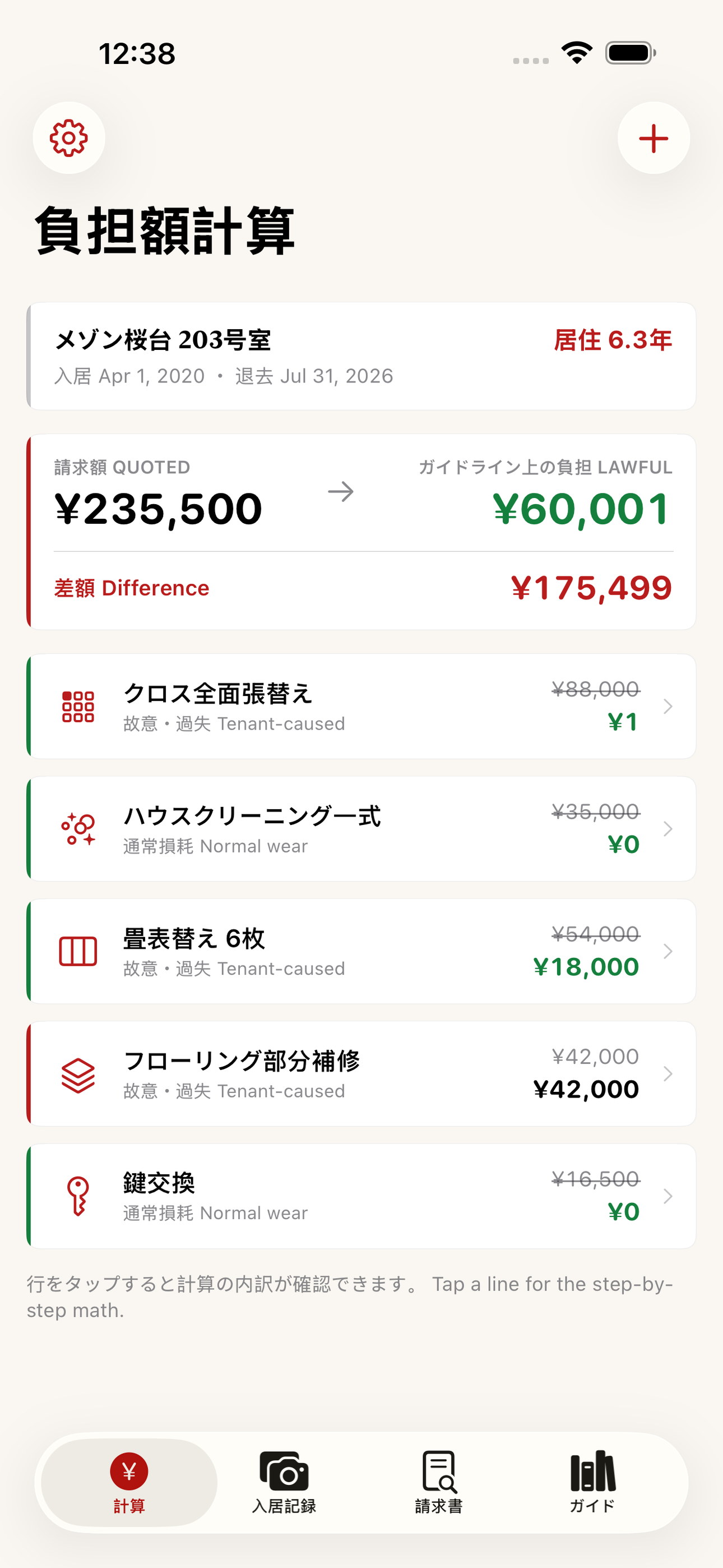
- Invoice Challenge Sheet — Recreates the landlord's restoration invoice line by line next to the guideline-computed tenant share, totals the gap, and flags items the guideline assigns to the landlord (normal wear, aging, sun-fading).
- Negotiation Letter Builder — Generates a polite, formal Japanese letter disputing the overcharged lines, citing the specific MLIT guideline sections and the depreciation math, ready to send to the management company or bring to a consumer affairs center — with full PDF export of letter, sheet, and photo evidence.
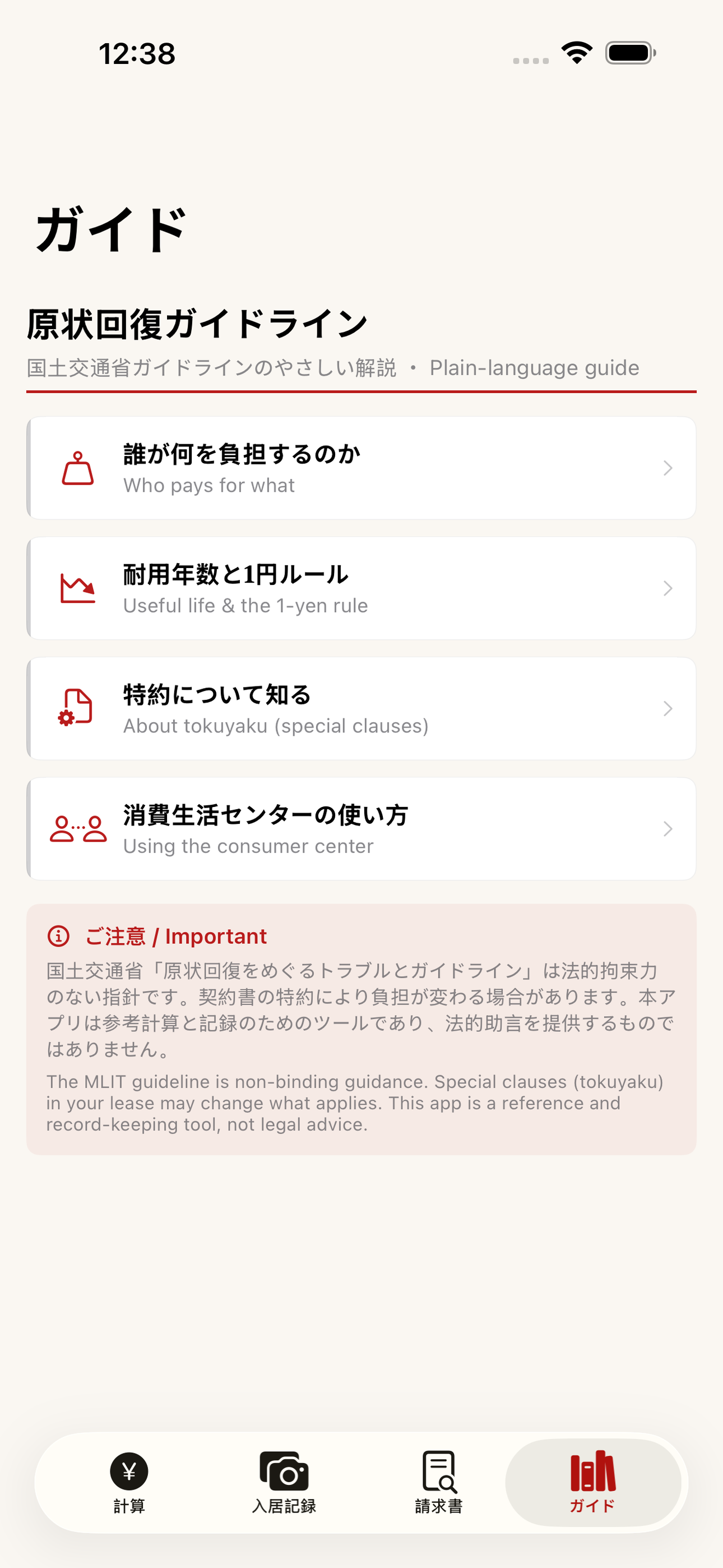
- Guideline Reference — A plain-language, Japanese-and-English library of what the MLIT guideline actually says: who pays for what, the useful-life table by material, and what a tokuyaku special clause can and cannot override — with the mandatory not-legal-advice disclaimer.
Why we built it
Japanese tenants get billed for full wallpaper, tatami, and cleaning restoration at move-out even though the MLIT guideline assigns normal wear to the landlord and depreciates materials to a 1-yen residual over ~6 years. NCAC logs ~13,000 consultations a year on this, the only human alternative (敷金診断士) costs 16,000-24…
What makes it different
The only tenant-side app that encodes the MLIT restoration guideline as a calculator plus an evidence system. Versus competitors: 敷金診断士 consultants charge 16,000-24,000 yen per case, are slow, and are not preventive; Remodela AI退去検査 and GMO賃貸DX are B2B inspection tools sold to landlords and property managers — the opp…
Who it's for
Freelancers, contractors, and small-business owners who want their numbers right at tax time without renting a SaaS to do it.
In one line: Fair move-out fees in Japan
Try it
See the Fair move-out fees in Japan for the full feature list, the info table, and support links.
Use Taikyo Check, found a bug, or have a feature request? Comments are open below — anonymous is fine.
0 comments
No comments yet — be the first.
Leave a reply
Sign in with Google to join the conversation. We require a quick sign-in to keep comments spam-free.
Sign in with Google to comment