Meet PumpTicket — Septic trip tickets, offline
Every load you pump is a legal record.

Business
PumpTicket
Septic trip tickets, offline
Every feature, from the first launch.
No account, no login, no cloud. Everything runs on your device and works fully offline — nothing in this post is hidden behind a wall.
What PumpTicket does
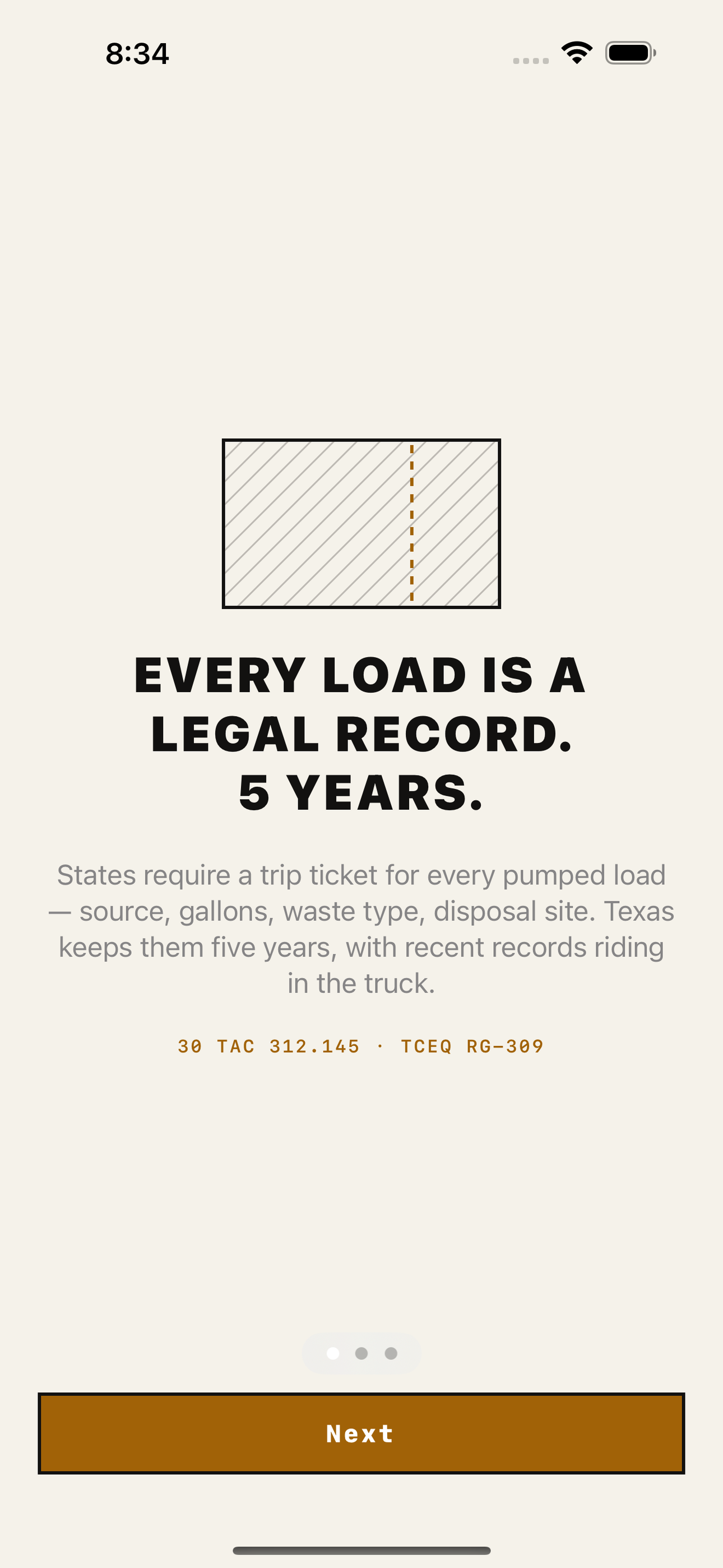
Every load you pump is a legal record. Texas requires a trip ticket for every septage load — source address, gallons, waste type, receiving facility — retained for five years, with recent treatment records riding in the truck (30 TAC 312.145, TCEQ RG-309). Michigan runs a licensed septage program with its own recordkeeping rules. Most states sit somewhere in between, and every receiving plant wants a manifest before the valve opens. Yet the tool of record for the one-truck pumper is still a carbon-copy pad filled out on the hood in the rain and filed in a shoebox behind the seat.
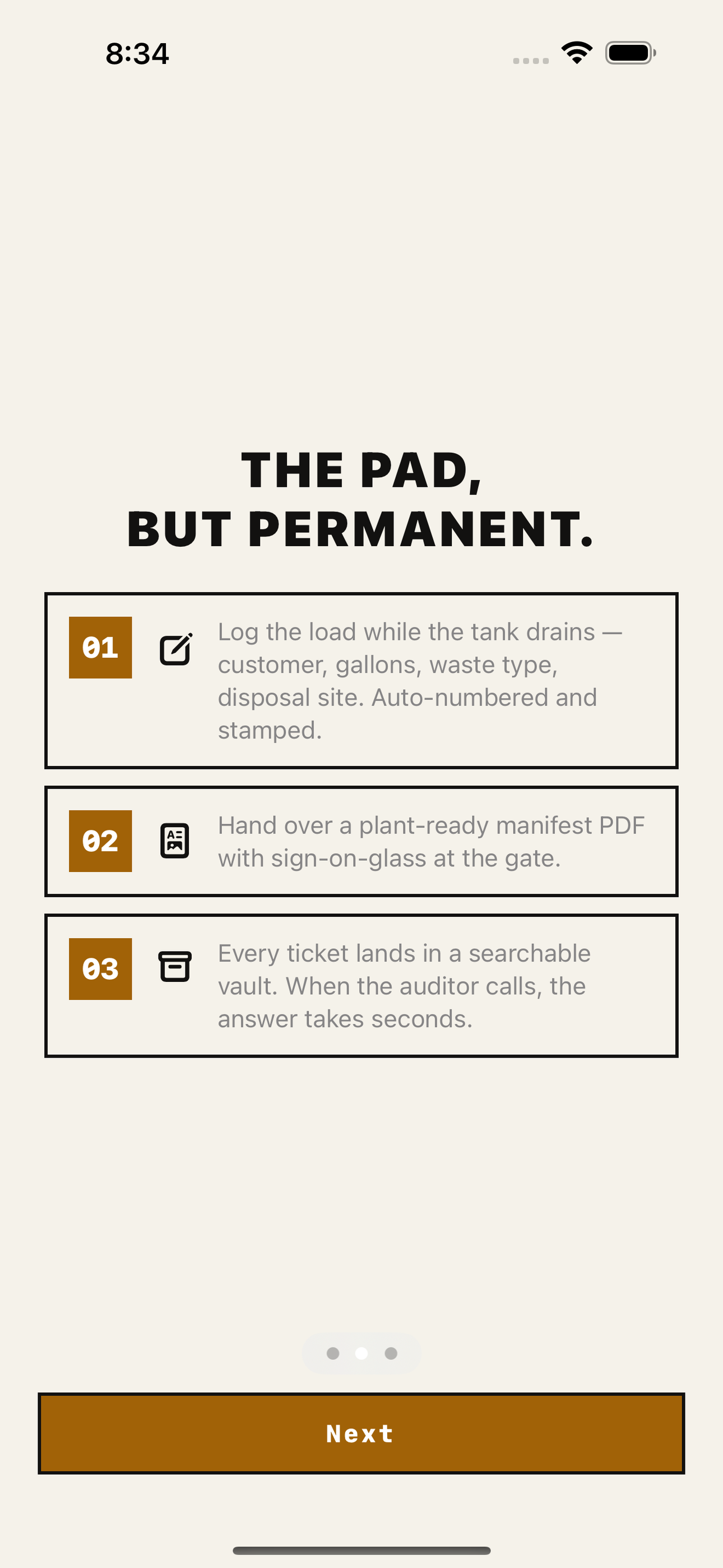
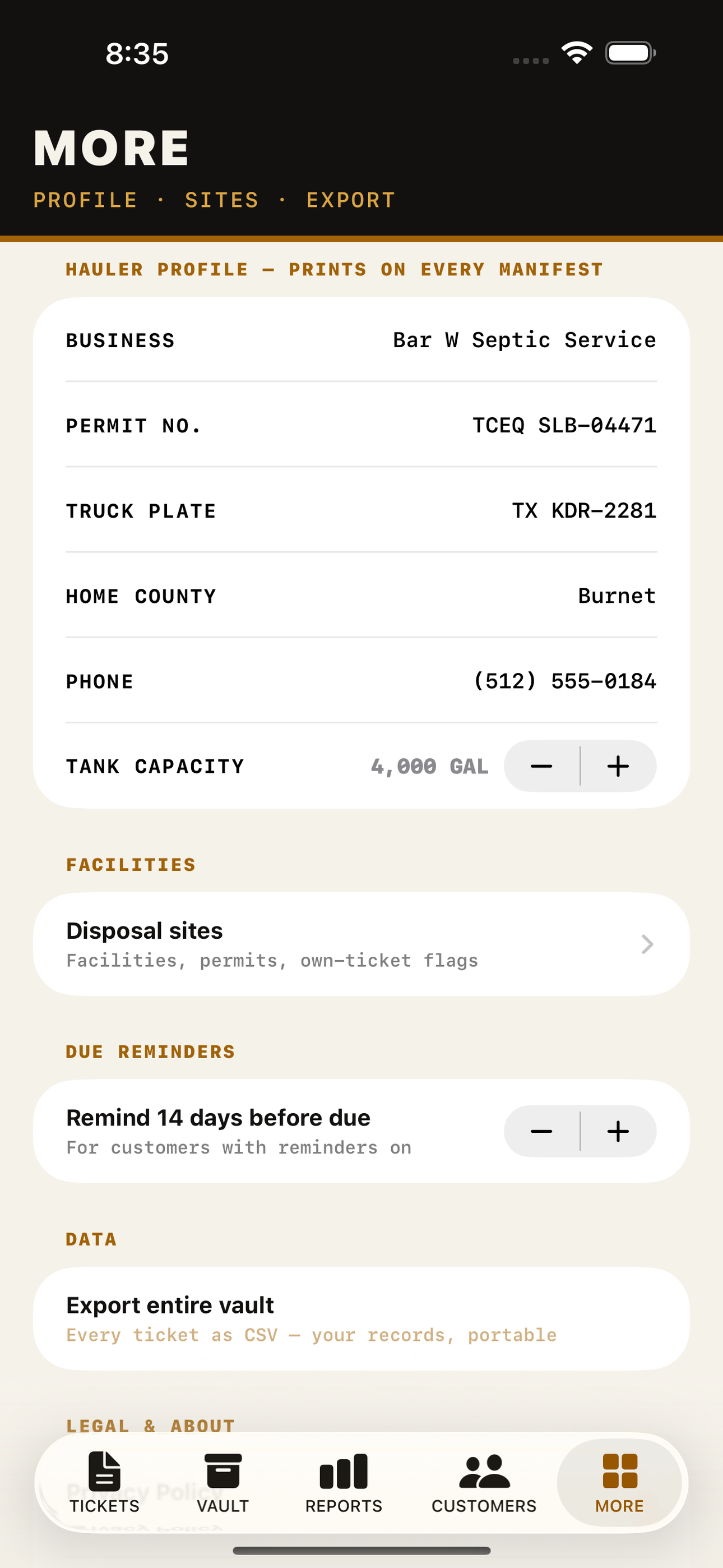
PumpTicket replaces the pad. Log a load in the time it takes the tank to finish draining: pick the customer, confirm the source address, punch in gallons and waste type, choose the disposal site, and let the customer sign on the glass. The app numbers the ticket, stamps it, and renders a clean manifest PDF you can hand over, print, or send — laid out like the paper form the plant already knows. Some facilities insist on tickets they furnish themselves; copy your numbers straight across, and your permanent copy still lives in the vault.
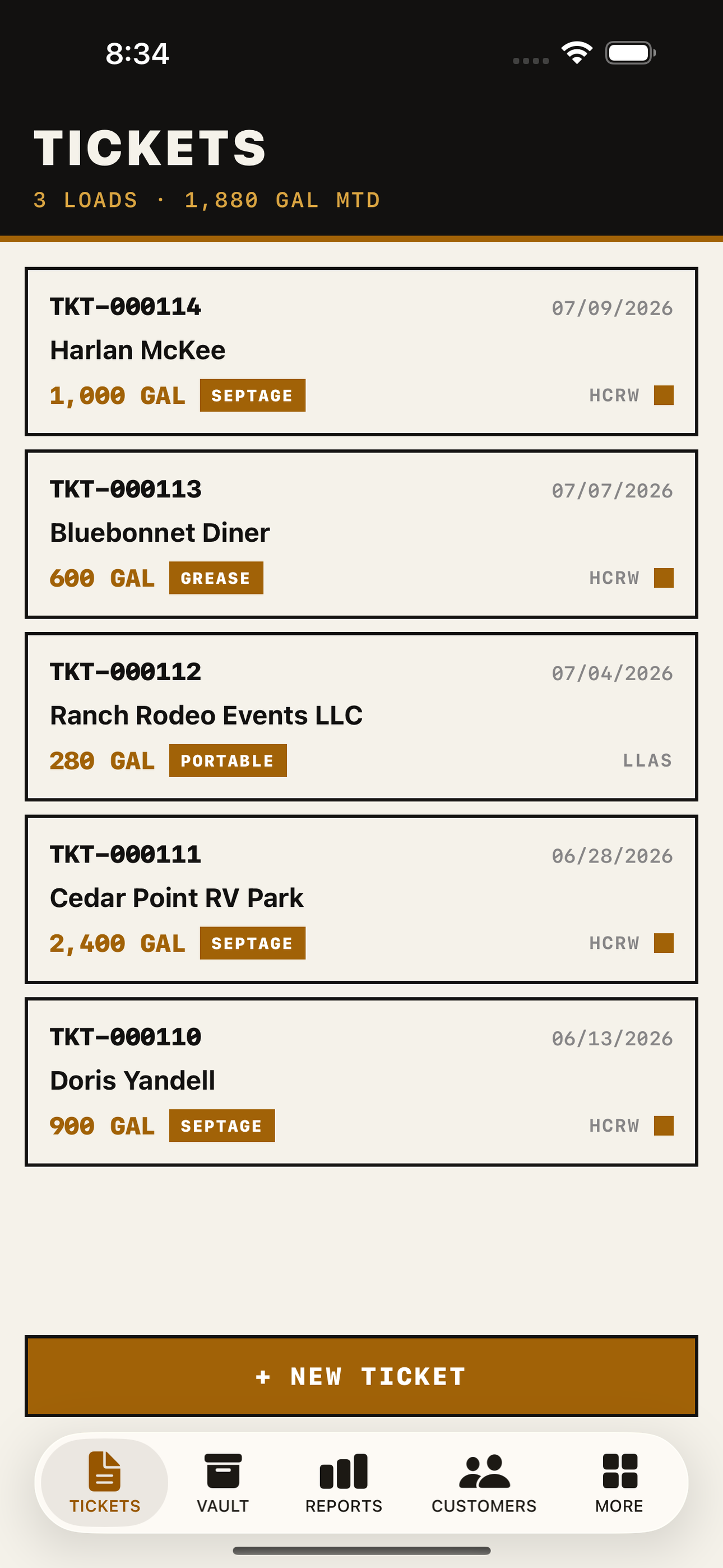
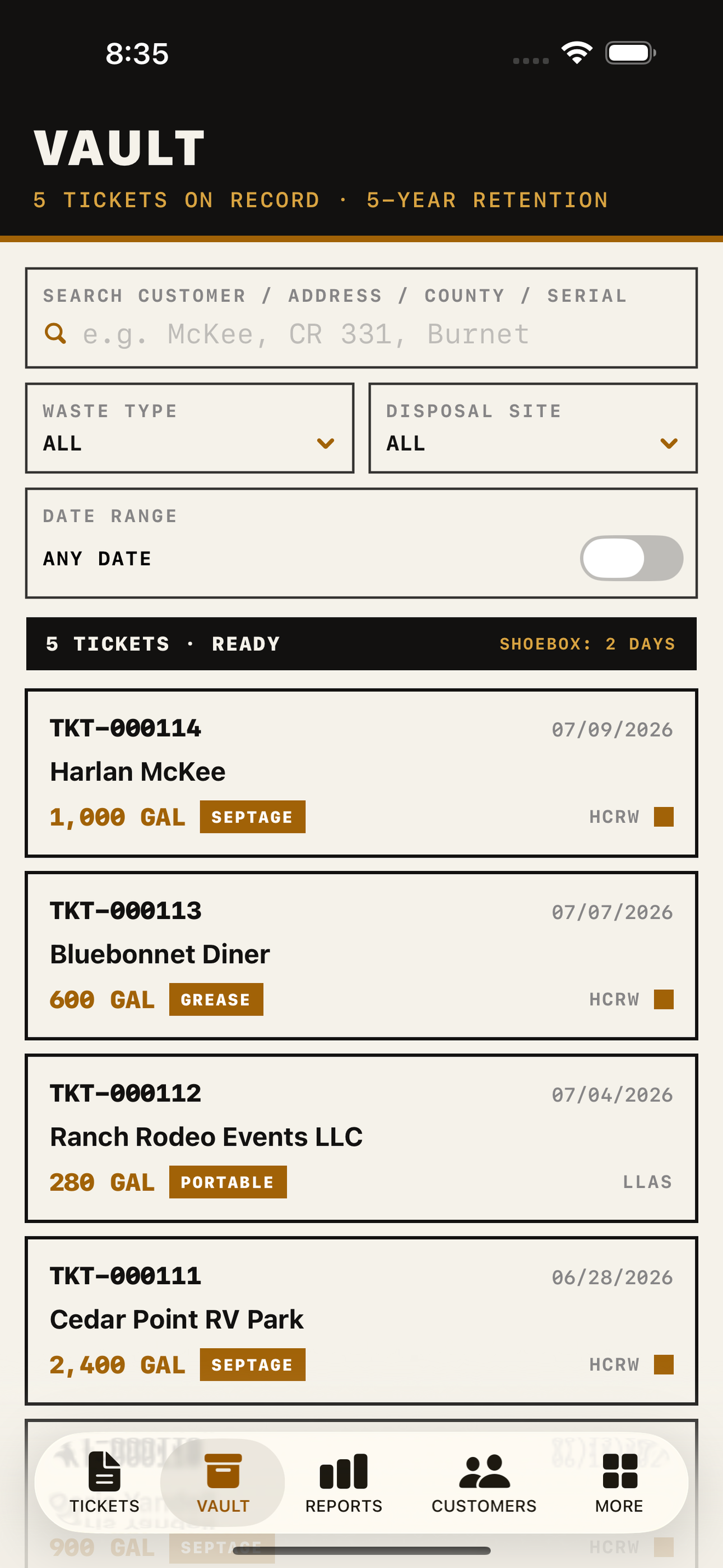
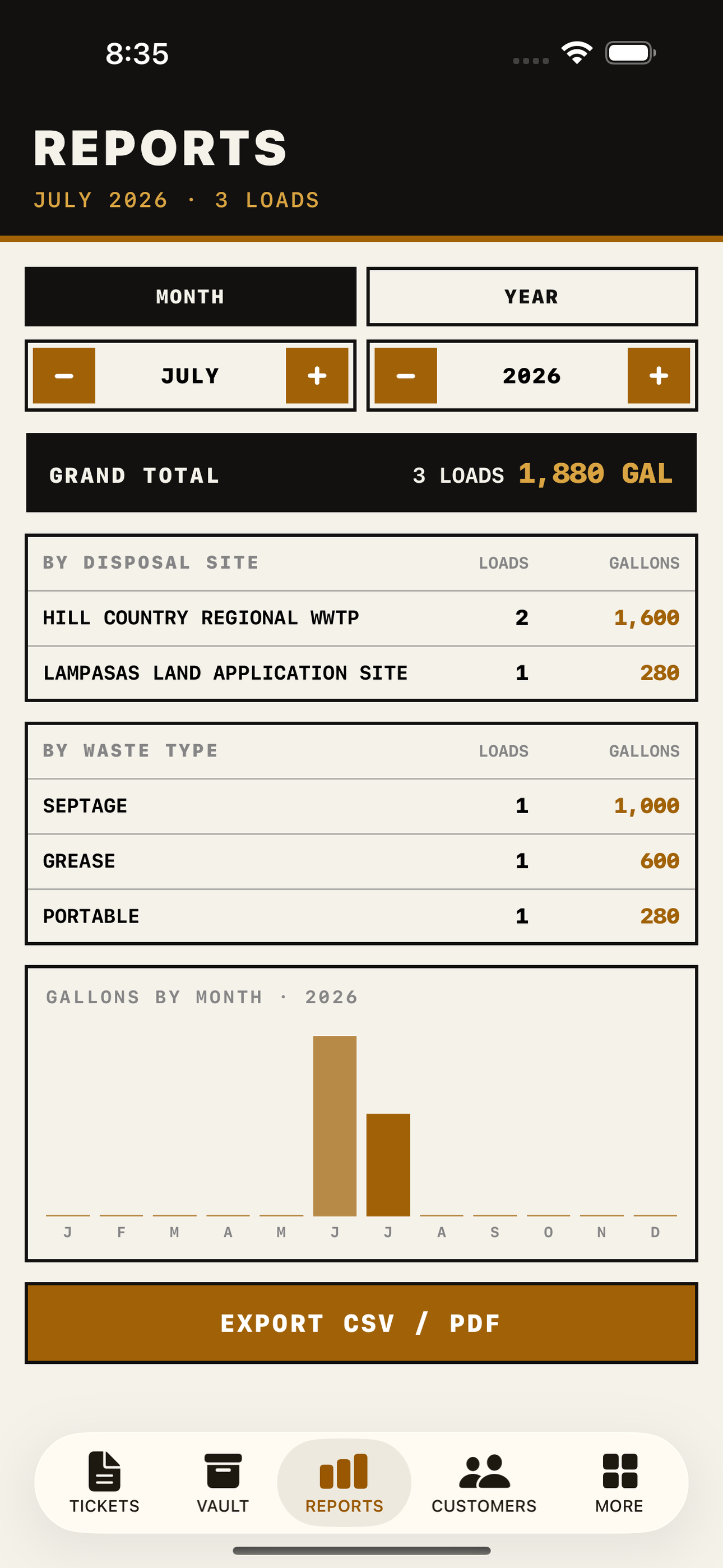
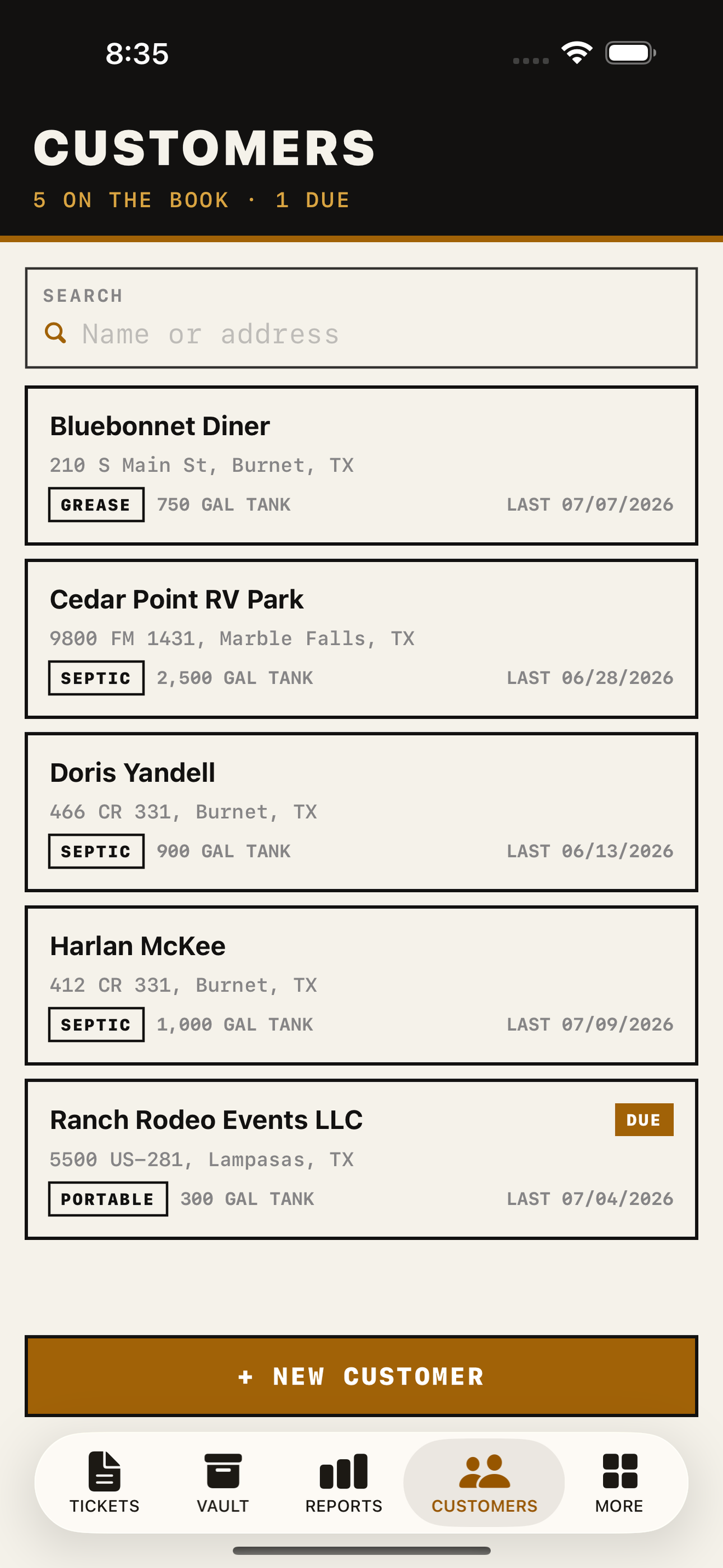
That vault is the point. Every ticket is searchable by customer, address, date, county, waste type, and disposal site, so when the county health office calls asking when you last pumped a tank, the answer takes seconds instead of two days of shoebox archaeology. Month-end and year-end gallons totals by disposal site roll up automatically for state filings, and customer history shows every past visit with a next-pump-due date, so repeat work comes back to you instead of the other guy.
PumpTicket works entirely offline — at the rural tank where cloud software has no bars — and it is not a subscription. It is a record book, built for the owner-operator who wants the ticket and the five-year vault, not a dispatch CRM with a monthly bill.
• Thirty-second trip ticket: source, gallons, waste type, disposal site • Manifest PDF with customer signature, ready at the plant gate • Searchable five-year retention vault: customer, address, date, site • Disposal-site totals plus monthly and annual gallons reports for state filings • Customer history with next-pump-due reminders • Grease trap and portable restroom loads on the same ticket • Fully offline, no account, no monthly fee
A look inside
Tap any screenshot to open the full-resolution version.
What's inside
- Thirty-Second Trip Ticket — One screen logs the load while the tank drains: customer, source address, gallons, waste type (septage / grease / portable), disposal site, truck — auto-numbered and date-stamped like a serial ticket.
- Manifest PDF & Signature — Renders each ticket as a plant-ready manifest PDF modeled on the carbonless paper form, with customer sign-on-glass capture and share/print at the gate; per-site flag for facilities that furnish their own tickets.
- Five-Year Vault — Every ticket permanently retained and searchable by customer, address, date range, county, waste type, and disposal site — the two-day shoebox hunt becomes a five-second query when the auditor calls.
- Gallons & Site Reports — Monthly and annual gallons totals rolled up by disposal site and waste type for state filings and plant reconciliation, exportable as PDF or CSV.
- Customer Book & Due Reminders — Every customer's full pump history with tank size and interval, computing a next-pump-due date and local reminder so the repeat job lands with you.
Why we built it
States legally require a trip ticket/manifest for every pumped load (Texas: 5-year retention, records in the truck), but solo pumpers run this on fading carbon-copy pads in a shoebox — and the only software alternatives are monthly web SaaS built for multi-truck offices that dies without cell signal at rural tanks.
What makes it different
Tank Track and PumpDocket are monthly cloud SaaS aimed at septic companies with office staff — accounts, internet, ongoing fees, dispatch and CRM baggage a one-truck pumper resents; Jobber ($29-149/mo) is generic field service with no gallons/waste-type/disposal-site manifest model; SepticOS claims offline-ish mobile…
Who it's for
Operations leaders and small teams who want a tool in their workflow without buying another platform.
In one line: Septic trip tickets, offline
Try it
See the Septic trip tickets, offline for the full feature list, the info table, and support links.
Use PumpTicket, found a bug, or have a feature request? Comments are open below — anonymous is fine.
0 comments
No comments yet — be the first.
Leave a reply
Sign in with Google to join the conversation. We require a quick sign-in to keep comments spam-free.
Sign in with Google to comment